21 Branching Process

Random Process

A random process is a family {Xt,t∈T} of RVs indexed by some set T, i.e. Xt:Ω→S.
S is called state space.

Xt "evolves" as time passes in a random but prescribed way.

1 GaHon-Watson Branching Process

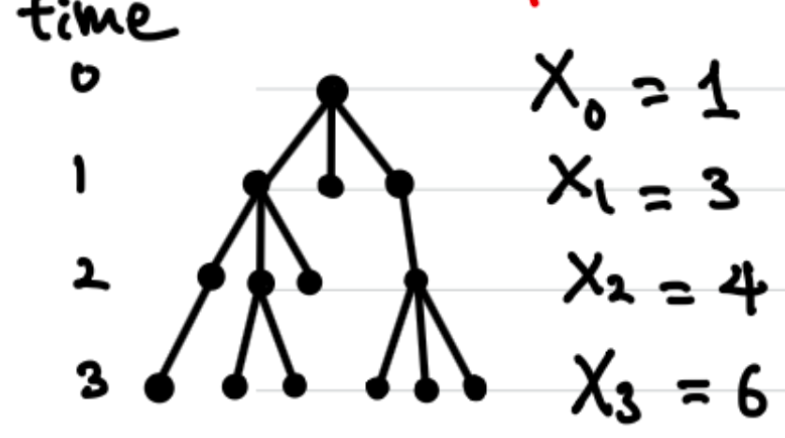
This model has historical context in family name propagation (Galton, 1889) and free neutrons in nuclear fission reactions (1930's). Denote T=N, S=N0, Xt is number of particles at time t.
Pasted image 20241127000405.png|300
Each particle gives birth to k∈N0 children with probability pk, independently of other particles in the past and present.

Assumptions

Let F={pk|k∈N0} denote the offspring number distribution with mean μ<∞, and variance σ2<∞.
Denote Bi(t) as the children generated by i th node at time t. So B1(t),⋯,BXt(t)∼i.i.dF and are independent from Xt. So Xt+1=B1(t)+⋯+BXt(t), P(Bi(t)=k)=pk.

By Wald's Identity, E(Xt)=μE(Xt−1)=μ(μE(Xt−2))=⋯=μtE(X0).
Typically X0=1. So E(Xt) increases geometrically if μ>1 (supercritical); decreases geometrically if μ<1 (subcritical); remains constant if μ=1 (critical).
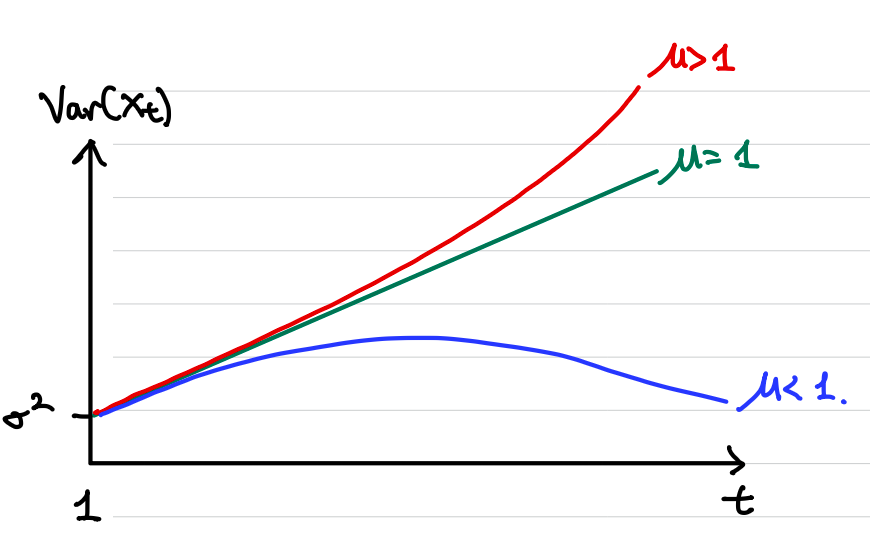
By Law of Total Variance, Var(Xt)=σ2E(Xt−1)+μ2Var(Xt−1)=σ2μt−1+μ2(σ2μt−2+μ2Var(Xt−2))=σ2(μt−1+μt+⋯+μ2t−2)={σ2t,μ=1,σ2μt−1(1−μt1−μ),μ≠1.
The figure may look like:

Pasted image 20241127004828.png|300
For all GW processes, the state 0 is the absorbing state. (Xt=0⇒Xt+1=0.)

2 Extinction Probability

Definition

  • Extinction Time τ=min{t∈N|Xt=0}; τ=∞ if there exists no such t.
  • Extinction Probability P(τ<∞).

Claim

P(τ>t)≤μt.

Hence if μ<1, the extinction occurs with probability 1.

Key tool for computing the extinction probability is the PGF.
Consider a Galton-Watson process {Xt,t∈N0} with offspring number distribution F={pk|k∈N0}. For B∼F, define φ(s)=E[sB]=∑k=0∞skpk.

Then φ is non-linear.

Claim

Let φt(s)=E(sXt)=∑k=0∞skP(Xt=k) (PGF for Xt.) Then φt+1(s)=φ(φt(s))=φt(φ(s)),∀t∈N0.
If X0=1, then this implies that φt(s) is the t−fold composition of φ, i.e. φt(s)=φ(φ(⋯(φ(s))⋯))⏟t times.

Claim

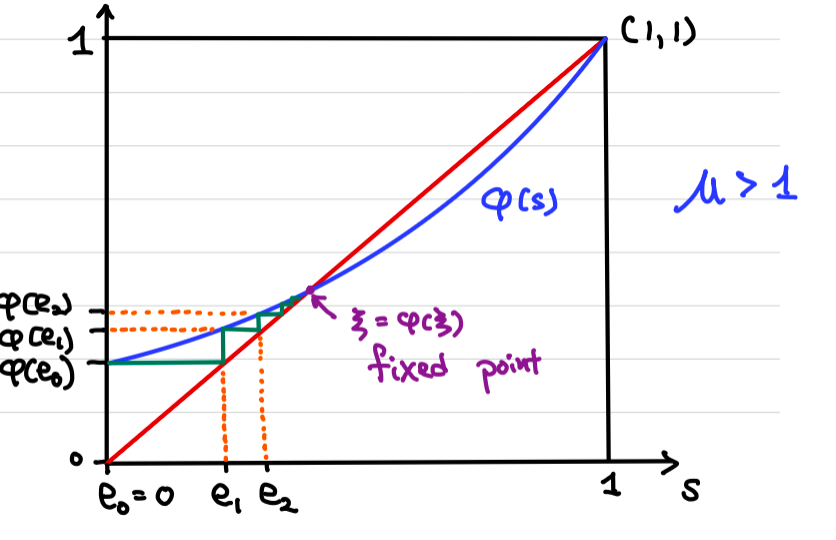
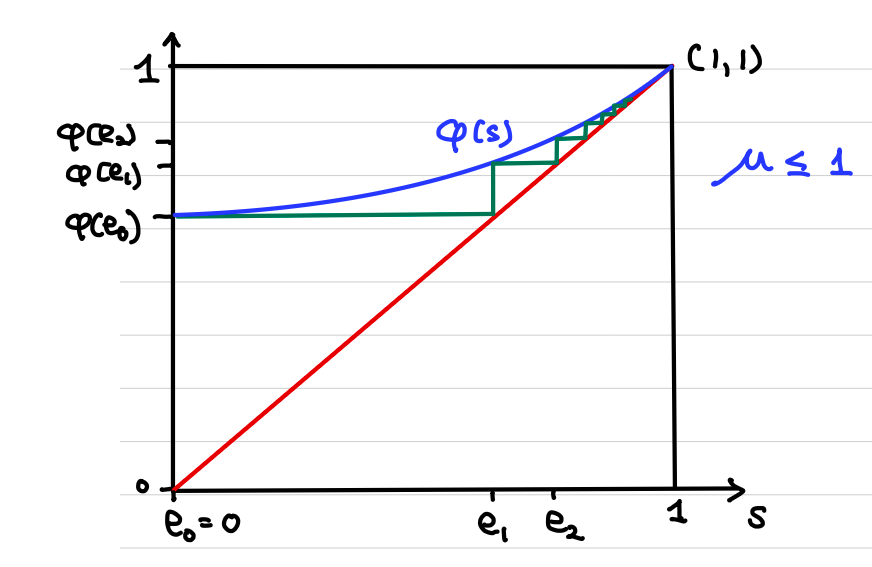
Let et=P(Xt=0) be the probability of extinction by time t. Then et=φ(et−1).

When e0=0,et=φt(0), extinction probability is limt→∞φt(0).

Pasted image 20241127011300.png|400
Pasted image 20241127011404.png|400

Claim

The probability of extinction ξ=P(τ<∞) is the smallest non-negative solution of the fixed point equation (1)s=φ(s).

Theorem

Unless pk=1, the fixed-point equation (1) has either one or two solutions.

  1. Supercritical (μ>1) case has a unique solution ξ less than 1.
  2. Critical (μ=1) and subcritical (μ<1) cases have only one solution ξ=1.
Theorem

Suppose {Xt|t∈N0} is a Galton-Watson process with offspring number distribution F={pk|k∈N0}.

  1. (Geometrically decaying tail) If μ<1, then P(τ>t)∼cFμt as t→∞, where cF∈(0,∞) is a constant that depends on F.
  2. (Fat tail) If μ=1, then P(τ>t)∼2σ2t as t→∞. Then E[τ] is finite.